
Protecting Your Gas Suppression Investment
SANS 14520-Compliant Enclosure Integrity Testing Across Gauteng
Morimi Fire Solutions performs room integrity testing, also known as door fan testing or enclosure integrity testing, for gaseous fire suppression systems across Johannesburg, Pretoria and Gauteng.
Required under SANS 14520 and ISO 14520, this test verifies that a protected enclosure is sufficiently airtight to retain the suppression agent at the design concentration for the minimum required holding time, ensuring your system will actually work when it matters most.
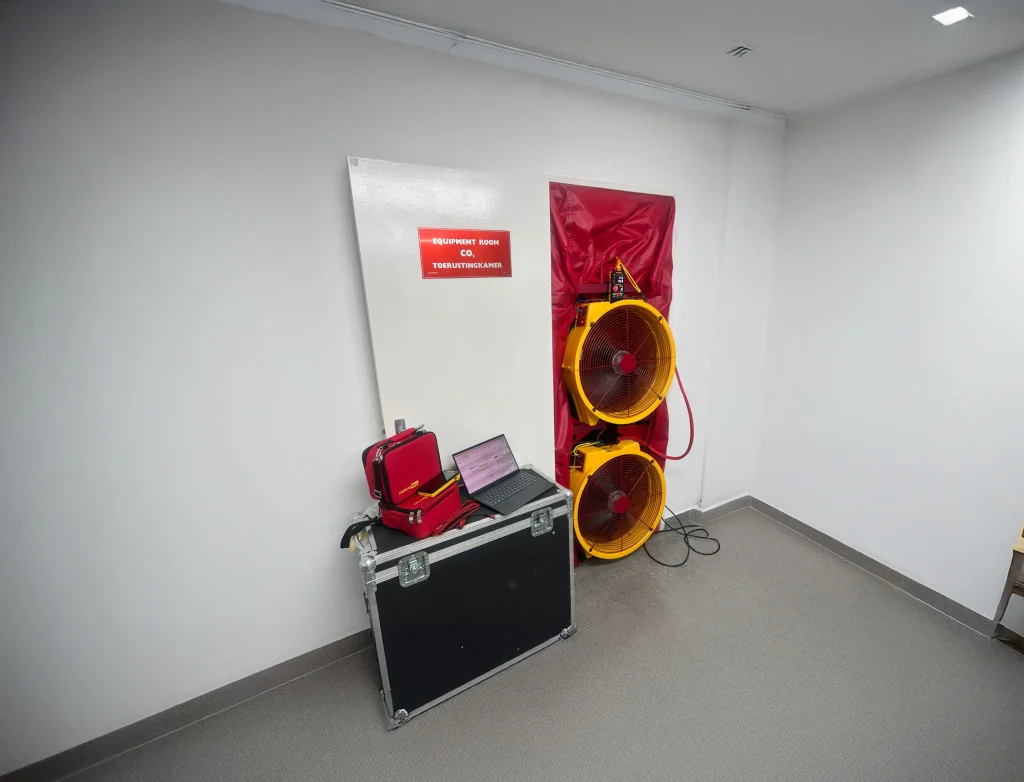
We operate a double fan test rig capable of testing enclosures up to 2,900 m³, one of the largest testing capacities available in Gauteng, covering everything from small server rooms to large data centre halls and industrial facilities.
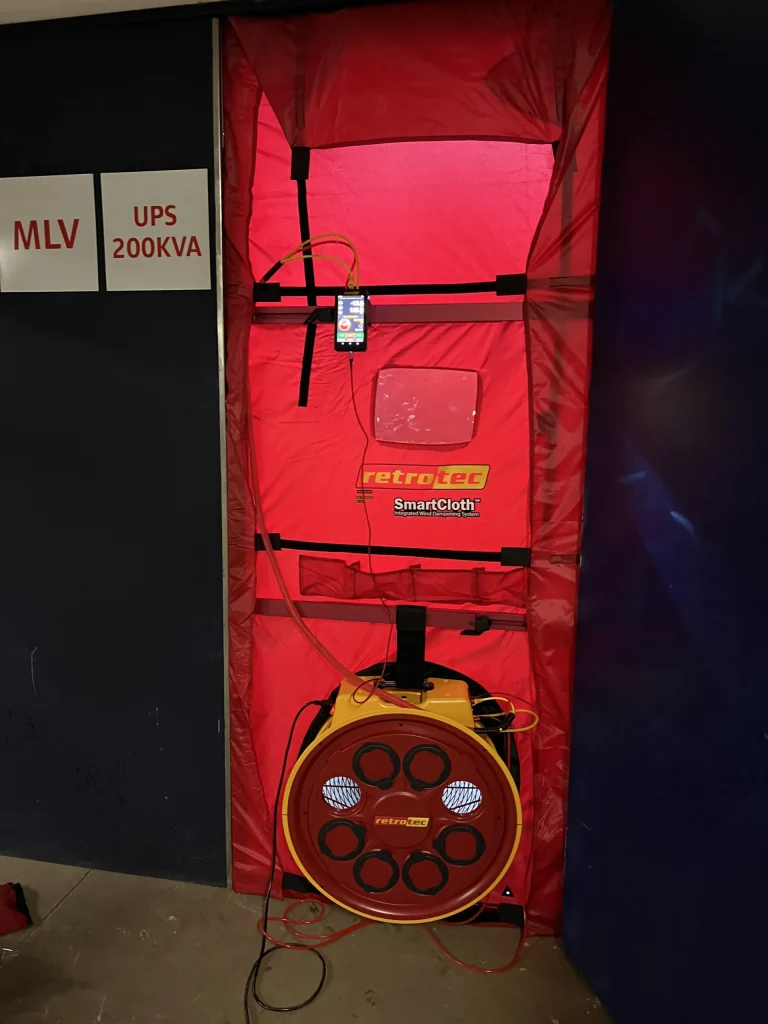
Enclosure Integrity Testing
How It Works

Pressurization
A calibrated fan or blower is temporarily installed in an external opening of the enclosure (typically a door or panel).
The enclosure is pressurised to approximately 50 Pa above ambient, simulating the pressure differential created when the suppression agent discharges.

Leakage Measurement
The test equipment measures the volumetric airflow required to maintain the test pressure.
This allows the effective leakage area (ELA) of the enclosure to be calculated, identifying whether the room has sufficient airtightness to hold agent concentration.

Acceptance Criteria
The measured leakage is compared to the maximum allowable leakage defined in SANS 14520 and the system designer’s specification.
The required holding time is typically 10 minutes at design concentration, any excess leakage will cause the agent to dissipate below effective levels before the fire is fully suppressed.

Verification
A SANS 14520-compliant test certificate is issued on passing the test, documenting the predicted agent retention time.
This certificate is required for insurance compliance, occupancy certificates, and annual system audits.
Integrity Testing Is Not Optional
Why Every Gas Suppression System Needs an Integrity Test
A gas suppression system is only as effective as the enclosure protecting it. Even a perfectly designed and installed FM-200, Novec 1230, IG-55, or IG-541 system will fail to suppress a fire if the protected room leaks too much, the agent simply disperses before it can do its job.
SANS 14520 and ISO 14520 both require that the enclosure housing a gaseous suppression system be integrity tested before commissioning and at defined intervals thereafter. Without a valid integrity test certificate, your system cannot be formally commissioned and your insurer may decline a fire-related claim.
When Is an Integrity Test Required?
- At initial commissioning of any new gaseous suppression system
- After any structural modifications to the protected enclosure – including new cable penetrations, partition changes, raised floor alterations, or HVAC modifications
- As part of annual maintenance and recertification of the suppression system
- When an insurance assessor or fire engineer requests evidence of system compliance
- After any discharge of the suppression agent
Integrity testing is required for all gaseous suppression systems. If you are also evaluating suppression options, see our pages on High Pressure Inert Gas Suppression (IG-55 & IG-541) and Low Pressure Clean Agent Systems (FM-200 & Novec 1230).
Double Fan Integrity Testing Available
Enclosures Up to 2,900 m³
Morimi Fire operates a double fan test configuration for large enclosures, making us one of the few providers in Gauteng capable of integrity testing large data centre halls, industrial plant rooms, and multi-zone facilities in a single test run.’
FAQ
Frequently Asked Questions – Room Integrity Testing
A room integrity test, also called a door fan test or enclosure integrity test, measures how airtight a protected enclosure is. A calibrated fan temporarily pressurises the room and the leakage rate is measured. This determines whether the room is tight enough to hold the suppression agent at the required design concentration for the minimum holding time specified in SANS 14520, typically 10 minutes.
Yes. SANS 14520 (the South African standard governing gaseous fire extinguishing systems) requires that the protected enclosure be integrity tested before a system is formally commissioned, and at regular intervals during its service life. Most insurers also require a valid integrity test certificate as a condition of cover for fire suppression systems.
An integrity test is required at initial commissioning and must be repeated whenever the enclosure is modified, for example after cabling works, HVAC changes, partition alterations, or raised floor modifications. Annual re-testing is best practice and is commonly required by insurers and maintenance contract specifications.
If the enclosure fails, Morimi Fire will provide a detailed report identifying where leakage is occurring. In most cases, remedial sealing works, filling cable penetrations, sealing raised floor voids, or attending to door seals, can resolve the issue, after which a retest is performed. We manage the full process.
Morimi Fire operates a double fan test configuration capable of testing enclosures up to 2,900 m³, covering everything from small IT closets and server rooms through to large data centre halls and industrial plant rooms across Gauteng.
A standard single-zone test on a server room or small data centre typically takes 2–4 hours including setup, testing, and initial reporting. Larger enclosures requiring double fan configuration may take a full day. Testing can generally be scheduled to minimise disruption to active operations.
Get hold of us
Contact Us
Need a SAQCC-registered fire suppression specialist in Gauteng? Morimi Fire Solutions provides free site assessments, custom system design, professional installation, and ongoing maintenance across Johannesburg, Pretoria, Germiston, and surrounding areas.
Contact us today to request a quote or schedule a fire risk assessment.
79 Watt Street, Meadowdale, Germiston, Gauteng, South Africa